Search Our SiteLeerburg 2008 Catalog Weekly Newsletter Request a Catalog Download Catalog Table of Contents Dog Training Videos New Releases DVD DVD Box Specials FREE Streaming Video Dog Training Equipment Dog Training Equipment Dog Training Books K9 Healthcare Products Web Forum Discussion Discussion Forum How to Register Dog Training eBooks Dog Training Podcasts Dog Training Articles Articles Question & Answers Leerburg Kennel Our Kennel Current Litters Customer Testimonials Stud Dogs Adult Dogs for Sale Our Kaiserhaus Malinois Dog Training Categories Dog Training Dog Obedience Training Aggression Problems Dominance Problems Dog Fight Problems Puppy Training HouseTraining Problems Feeding Dogs Breeding Dogs Electric Collar Training Schutzhund Training Police K9 Training Leerburg's Top DVDs Your Puppy 8 Weeks DVD Basic Dog Obedience DVD Electric Collar Training DVD Dominant Dogs DVD Raising a Working Pup DVD Bite Training Puppies DVD All 120 Dog Training DVDs How to Order View Shopping Cart Foreign Orders Shipping Charges See Our Horses Request a Catalog Contact Us
|
Introducing Dogs (or Puppies) DVD's to help in this training process
Read this article as a FREE eBook I am often asked how to make a new puppy (or dog) get along with the family cat or cats. My answer is always "this is a simple thing to do as long as you are willing to educate yourself on canine pack behavior and make a few changes in the way you live with your cats." I remind people that cats can instigate problems with dogs. This is not always a one sided problem. The average dog owner is completly unaware of how strong the genetic pack drive is in the domestic dog. Our dogs live their life by a set of genetic rules they are born with. The sucess of this program depends on:
Over the years I have introduced a number of dogs to our cats. We currently own 5 cats. Four inside outside cats at our kennel and one is our house cat. Our dogs have accepted and lived with my cats without problems. I would have bet a lot of money that a couple
of my past police dogs would never have accepted a cat. Had they not gone through our program they would have killed our cats. With that said, over the years I have had a couple of dogs that I would never trust to be around my cats when I was not there. Had I made the mistake and allowed these dogs to be unsupervised when with our cats there is little doubt the dogs could have killed a cat. The solution to a sucessful dog-cat ssituation with these dogs was to control the enviornment these animals were around one another and to insure that the dog was ALWAYS under my control, either with a dog crate, a dog leash or a remote collar.
I recommend the use of a dog crates. The use of a dog crate is the safest way to make sure you can control the enviorment. It allows you to focus on the cats while the dog is in the room. In the beginning cats are put in a separate room before the dog is brought into the house. I always put my new dogs on leash when I bring them into the house. This shows them that coming into the house is a controlled experience and not someplace where the dog can charge around and act crazy. In other words I ALWAYS control the animals and the enviornment I allow the animals to be in. Thats how accidents are avoided. I don't leave things to chance. By having the dog on leash I have control of him if the cat runs and he tries to chase. People often ask "When can the dog be off leash?" The answer is simple - when you can control the dog under distraction. If you can't call your dog to you when it is highly distracted by your cat - then the dog is not under your control and it should either be on leash, in a dog crate or wearing a remote collar. This test can be made by made by putting the cat in the dog crate before the dog is brought into the house. The dog should be on leash. The owner can drop the leash and let the dog drasg it. If the dog then gets out of control and won't mind the handler can simply grab the leash and take the dog back outside outside.
A family Kitty investigating the new smells of the new pack member The decision to correct or not correct the dog or how hard to correct the dog depends on if you are training the dog or just testing the dog. I wrote a free ebook titled "THE THEORY OF CORRECTIONS IN DOG TRAINING" You may want to review that material. IN THE CRATE Once in the crate the dog is expected to be calm and quiet. If the dog barks at the cats they are verbally scolded. If they will not stop barking we either cover the crate with a sheet, spray lemon water in the dogs face or make them wear a No-Bark collar. We normally don't use bark collars on puppies until they are 16 weeks old. The dog is never allowed to be in the house and out of the crate unless it's on leash. It's never taken out of the crate (on leash) when the cat is in the room until it has gone ONE WEEK wihtout barking at the cats. This does not mean the dogs are locked in dog crates for weeks at a time. They can have free (on leash) time in the house but in the beginning the cats are always put in a different room when the dog is out. When I get a new adult dog my first priority is to establish pack structure. I normally wait several weeks before I allow the dog to have on leash house time. This program is covered in detail in my dvd ESTABLISHING PACK STRUCTURE WITH THE FAMILY DOG If you are a new dog owner I highly recommend that you get this dvd and run your dog through this program. Cat owners who acquire dogs have two processes going on at the same time. They should be establishing pack structure with the new dog at the same time they are teaching the dog that their cats are now part of the dogs family pack. When owners take their time there are seldom problems.
During the period of time that an adult dog spends in the crate, he can be acclimated to a muzzle. I like the wire basket muzzles we sell because they are less restrictive to the dog. Dogs accept these muzzles quicker than the plastic muzzles we sell. The down side is they are a little more expensive. For those people who do not want to spend the money on a wire muzzle the plastic Jafco muzzles are inexpensive and work just fine. It is important to learn to put them on properly. When done incorrectly the dog could possibly get them off. We always us marker training to put muzzles on (refer to my ebook on marker training if you have questions on this)
Should the adult dog shows the slightest sign of aggression towards the cats it needs to get a correction. The severity of the correction will vary by the temperament of the dog. Some dogs simply need to be told NO !! - while other dogs require a level 10 prong collar correction. The correction needs to be strong enough that the dog will remember it the next time it thinks about being aggressive to the cats. If you have been doing your training correctly your dog will be looking at you as it's pack leader. Pack leaders determine when to use aggression - not lower ranking members of the pack. If a dog repeated ignores your warnings you have not done a good enough job of establishing yourself as this dogs leader. Should this be the case you need to go back to the pack strucutre training and work on that. You will also want to work on the dogs obedience training. He will instinctively accept you as pack leader and your position that cats are not prey items to chase and kill. The REMOTE COLLAR - When the muzzle comes off:
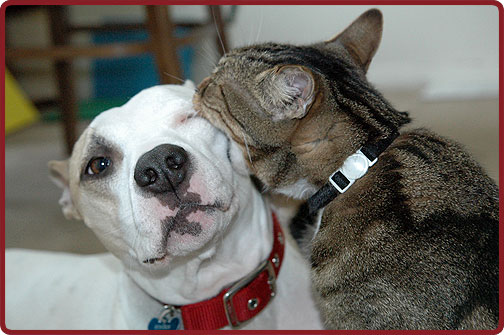
This should only happen when you are comfortable with your dogs actions when the dog is on leash and the cats are around. You must have patience. For adult dogs and cats this could take months. With time they will settle into a life style where both sides accept the fact that they now share the same territory. I prefer to proof dogs and cats with a remote collar. In my opinion using a remote collar is the safest quickest way to teach a dog that chasing cats is not a fun thing to do. When it's done properly this can have a life long effect on the dog. I did a training dvd titled REMOTE COLLAR TRAINING FOR THE PET OWNER In my opinion everyone who owns a dog should learn how to train a dog with "LOW LEVEL" stimulation. This training is fare more human than a choke collar or a prong collar. It provides off-leash control of the dog that reinforces recalls and gives the owner the possibilty of controlling off-leash unwanted behavior (like chasing cats). The fact at this stage of training if a dog still chases the cat I teach the dog that the cat is like touchinbg a hot stove. When the dog chases it gets a HIGH LEVEL correction. (not the low level we use in normal obedience training). Usually this only needs to be done once. After that if the dog even looks at the cat I say NO ! and give a low level correction. The concept here is to stop unwanted behavior BEFORE THE DOG IS IN HIGH DRIVE. The higher the drive the stronger the correction needs to be. There are many brands of remote collars on the market. Most border on "a waste of good money" While we could sell any brand we wish - we useand recommend DOGTRA COLLARS in our home and kennel. This decision is based on over 30 years of using remote collars. You can email use to ask what model we recommend for your dog. Dogs and Cats being friends The best of all worlds is when our dogs and cats become friends. I need to say that there is a fine line between allowing the dog and cat to get to know one another play together and creating a safe environment. Running in the house should never be allowed, even if it seems to be in play. When cats run this can easily trigger prey drive in the dog. I had the experience of seeing a neighbors dog kill a cat that the dog had lived with. The cat ran across the front yard. This dog had a lot of prey drive, it chased the cat and killed it before anyone could even attempt to stop it. This taught me a valuable lesson. That is, dogs may act one way in the home and a different way when they are outside. The moral of the story is error on the side of safety and be careful.

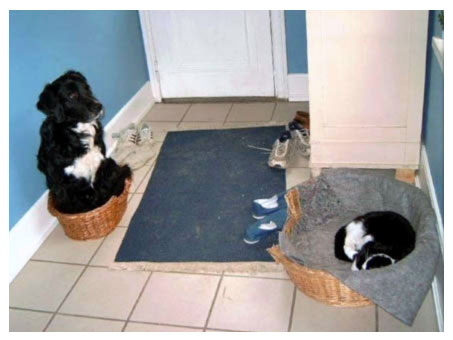
CATS and DOGS Some cats accept dogs better than others. One of our house cats (Garfield) came into the home as a kitten. The other (Fred) as an adult barn cat that was adopted. Garfield grew up with my old stud dog (Nick) He kind of adopted Nick as his best buddy. He looked at Nick as a heating pad. He would wait until Nick laid down and would go over and curl up on top of his tail and stomach. For months Nick would jump up and walk away in disgust. Over time they became friends with Nick eventually allowing Garfield to lay on top of him and curl up next to him whenever possible. He even allowed him to feed from the same food bowl while he was eating. This just amazed me because Nick was dog aggressive and would attack another male dog without hesitation. On the other hand Fred has never warmed to dogs. He learns to tolerate them on an individual basis, but he will always "hiss" if they come too close. He is no dummy, he knows who he can hiss at and who he must hide from. I think he uses Garfield as a litmus test. He watches how the dogs react to Garfield and then bases his response accordingly.
My son Jeff, Natan and Garfield (many years ago) Then there are those cats who torment dogs. They know exactly what buttons to push to get a dog excited or mad enough to chase. Our office cat (Sting) knows exactly where the end of the dogs leash is when it's tethered to a desk. He will sit just outside of the area and stair at the dog. If he can get a dogs attention he will jump straight up in the air and run away because he knows it drives the dogs nuts. When we see Sting do this we scold him. We either chase him away (as a good pack leader should) or we squirt him with a mater bottle. (as an kid would love to do) The bottom line is this says volumes to our dogs. It demonstrates leadership to the dog and don't for one minute kid yourself that the dog doesn't look at it like that.
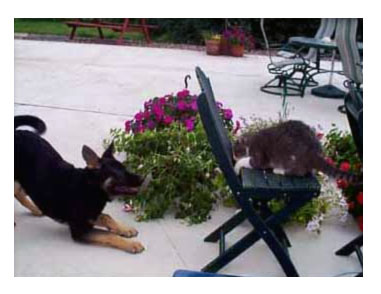
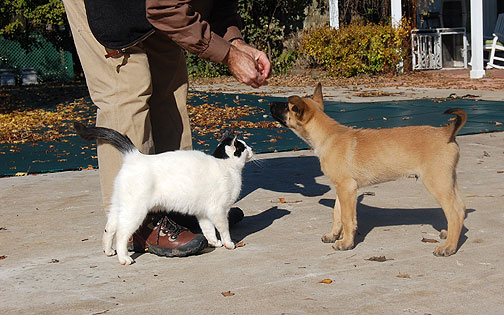
CATS and PUPPIES Many people get puppies and bring them into the home where there is an existing cat. Under these circumstances it's important to realize that a cat with claws can take a pups eye out in an instant. So if your cat has claws you need to be more concerned for your 8-week-old pup than for your cat. Follow the same steps with the dog crate. In this case, it teaches the cat that the dog is now a family member. If I have a pup with a lot of prey drive I will get a puppy prong collar and let him drag a line in the house. If he gets into trouble or tries to chase the cat I will correct him. It does not take many corrections to teach the dog that "NO" means "NO". It's very important to show the pup a lot of love after these experiences. He has to see that you do not hold any grudges and that you are still his best friend. So if you have to correct, then give ten times the cuddling after the correction. THE END With a little bit of luck you will be able to get your dog and cat to live together in peace. It's very important to remember to go slowly. No matter how quickly or badly you want it to happen, you have to allow these things to process at their own speed, which can be a snail's pace over months. The best advice I can give is to error on the side of caution and don't take chances with your pets lives.
DVD's That May be Needed for Training
Establishing Pack Structure with the Family Pet - 4 Hours Your Puppy 8 Weeks to 8 Months Basic Dog Obedience - 4 Hours Remote Collar Training for Pet Owners - 2 Hours 45 Minutes Dealing with Dominant & Aggressive Dogs - 3 Hours 30 Minutes
Question on Dog That Kills Cats: My mom and little sister live in country, and have several
cats. One of the cats they had was a very mean cat who did have her claws.
The other cats were rescued, and de clawed. They decided to get 2 purebred
German Shepherd puppies. They dogs and cats got along great, and the
dogs are very good dogs. The dogs are 1/2 brothers, and my mom has not
fixed the dogs, as the breeder has asked my mom to use them 1x for studding,
and would also like to show Bear. The dog are now almost 4 yrs old, and very well behaved. Bear is INSANE about balls. You would think he is Retriever!!! He and Wolf do play rough with each other as well, but when it comes to the cats, they are so gentle with all de clawed cats. The one cat 'Span ky' on the other hand has been awful to the dogs since they were puppies. She would scratch them on the nose any chance she got, she would do it when mom's back was turned, and of course when the dogs growled, or attempted to retaliate they got into trouble. Mom came home one day to Span ky lying in the bathroom, soaking wet (I mean dripping wet!). She rushed her to the vet, and was able to save her. The dogs never broke the skin, but as cats get abscesses, the area where the dogs grabbed her, the skin died and ripped open. (I guess I don't really blame the dogs for this, as she really was an awful cat, and if I were a dog I probably would have as well, but that doesn't excuse it...)
Nobody was concerned for the other cats, as like I said, the dogs got
on great with them. They would lick the cats, and the cats loved the
dogs. The would actually sleep on the dogs!!! With what happened to Spanky,
we were always cautious with leaving the cats alone with the dogs, and
would usually separate them into the basement (usually, but not always).
Well, my sister went to work on sunday, and she separated the cats from
the dogs (cats downstairs, dogs upstairs) but 'Spook', a very skiddish,
nervous cat must have darted thru the door with out my sister noticing.
When she got home from work, Spook was in the bathroom, dead, and again,
soaking wet. We tried to believe it wasn't the dogs, as there were no
bite marks, but I did do a close inspection of the body, and there were
2 small bruises on both sides of her body, as well as a large bruise
under her chin. There was blood in her mouth (and a small tooth missing)
and blood in one of her ears. I am sure the dogs did this, probably not
on purpose, maybe she just darted off somewhere, Bear was bored and saw
it as a moving ball, and maybe the were just playing with her, grabbed
her head, and strangled her by mistake (playing too rough). The only
explanation I have for her being wet is that they tried to lick her
alive once they saw she was dead. But it has now happened twice, and
we are all very disturbed. No one more than my sister, who of course
blames herself, and doesn't want anything to do with the dogs. (They
were her dogs, and she was incredibly attached) We don't know what
to do now. Should we put them down, or try to find a home? Regardless,
my mom works night shift and refuses to get rid of the dogs as it mean
my sister will be alone in the country at night. What if we do find a
home, and they do it again? Does anyone have any ideas as to what happened,
or what to do from here??? Ed's Answer About Dog That Kills Cats: OH PLEASE DON'T HUMOR ME WITH YOUR STUPIDITY ! What part of common sense did you miss !!!
Question On Dog That Chases Cat: Hello, I have a seven year old cat and recently adopted a ten month old toy poodle. The poodle is very sweet-natured, except when it comes to the cat. He will not leave the cat alone. My poor cat cannot get a drink of water without being chased. The poodle is not aggressive toward the cat, but he harasses the cat every time he moves! I want to correct this behavior, and my firm, "No's" are not working. Please advise me on remedying this problem. Thank you in advance for your time and advice. Sincerely appreciative, Answer to Dog Chasing Cat: I have written an article on How to Introduce a dog into a home with cats - You can find these if you go to the list of training articles and scroll down. With that said – your dog is not trained. If it were you could control it. You MUST train this dog – just because its small does not mean it should not be trained. I also recommend that you go to my web site and read the article I wrote on my philosophy of dog training. I think you will get some good ideas there You will probably find that you have not had the full picture on the steps of training a dog. Your dog must go through training steps before it can be considered fully trained. You will read why I am not a fan of taking an untrained dog to obedience classes. No professional dog trainer would ever take his dog to an obedience class with 15 or 20 untrained dogs and try and train it there. Its crazy. The dogs cannot concentrate with the distractions. I think if you read the testimonials on my DVD you will see that my customers feel the same way. If you make the decision to learn to train -
get a prong collar. You can read about it on my
web site. There is an article I wrote (with a
number of excellent photos) on how to fit a prong collar, you can also
read about the different types of prongs.
Question on Introducing Cats to Dogs: Hi, I am looking for a book or video on curbing animal
prey instinct. I have a 7 year old female Weimaraner that has started
killing cats. She lived with our cat since we got her (The dog had 2
other homes before ours). She seemed to like our cat so when our cat
died of old age we thought it would be ok to get a new kitten and the
dog killed it by shaking it. She ran in the door and snatched it up.
We also found 2 dead adult cats in our fenced backyard that she killed.
We have an adult cat also that we got the same time as the kitten she
killed. I want to teach her to accept the cat and that hunting inside
our house is not acceptable. We do not use this dog for hunting. Is this
possible or not. I am hearing a lot of weimaraners kill cats. Thanks
for your help Ed's Comments on Cats and Dogs: This is just an example of what can happen when the correct protocol is not followed when introducing a new cat into a home with dogs. Dogs that kill cats need serious obedience training and serious pack training. If this were my dog it would go through my protocol on GROUND WORK TO BECOMING A PACK LEADER. (read my article on this) It would be a long, long, long time before this dog was not tethered to me on a line while in the house. I would also be using an electric collar on the dog (in the house). There is also a protocol on how to use e-collars. I have written about this too.
Question on Introducing Cats to Dogs: Dear Mr. Frawley, Thank you Answer: Use a drag line (18" to 3 ') attached to a prong collar on the dog. If you cannot get a hold of that short of a line then make it longer. EVERY time that you say "NO" and the dog continues to chase it MUST get a strong, strong, strong correction. The dog must respect your authority and pack position or it will not stop this behavior. If the corrections are not strong enough the dog will not respect the command. This is a very, very simple concept. Some people cannot correct hard enough to make their dog respect them. These are either soft temperamented people, or extremely hard temperamented dogs. These people should use electric collars or get rid of the dog. The collars work ALL of the time. Question on Introducing Cats to Dogs: Hi Sincerely, Answer: The best route for this dog is a new owner. One that understands or tries to understand what is going on in a dogs head. You are making too many errors with this dog and unless you are prepared to make some changes you have created a disaster that is waiting to happen. I suggest you read my article titled Dealing With the Dominant Dog. You should have read my article on how to introduce dogs and cats. Had you introduced your pets properly you would probably not have had 2 dead kittens. You should approach the addition of this new dog in the same way as I explained to introduce cats. Just from your e-mail I can tell you that you are bringing these problems onto yourself. A dog SHOULD NEVER be allowed on the bed or even IN THE BEDROOM. This has nothing to do with fleas or dirt - it has everything to do with PACK DRIVE , RANK in the FAMILY PACK and DOMINANCE. Unless you are prepared to learn something about dog training my advice is to find new homes for both dogs. In my opinion you are putting your future child in danger. If you chose to keep these animals, at the very least you should get a prong collar and my training video Basic Dog Obedience. Read what I have to say about obedience training. I doubt that you have approached it in the manner I talk about.
Question on Introducing Cats to Dogs: I have a question. I got a new dog recently and he has been sweet to my cat. The cat on the other hand, strikes out and runs after him, attacking. The cat has lived with dogs before, and has always adjusted before, I think the cat is jealous of the dog since he is the new in the house. My dog has even got to the point where he cries if she hisses or growls at him they fight. The cat provokes it and seems happy when she gets him to fight back. I know part of it is the car wants to play, but is being very rough about it, and my dog would never hurt a fly. When the cat is not in an aggressive mood, she just walks by unfazed by him, maybe with a little hiss. I am worried that the cats behavior will cause him to dislike her, and never want to be friends with her. Yes, we do reprimand her (we do this 'sound' when she does a bad thing, and she knows what it means) when she picks fights but she does not really care. Answer: Cats need corrections just like dogs. I would put a number of cans around the house with rocks in them. When the cat does this I would be throwing these cans at it. I will guarantee you the cat will not like this. Spoiled cats are just as bad as spoiled dogs. Question on Introducing Cats to Dogs: Mr. Leerburg, My dog, a German Shepherd/Greyhound female mix - age 4 is becoming more and more aggressive with my 4 house cats. We got this dog as a puppy and introduced her into our home which had 2 other female dogs and the 4 existing house cats. She used to fight with the other dogs and I had been advised that she was trying to be the top dog in the house. Unfortunately are other dogs have passed away. The attacks on the cats are unprovoked. This morning my dog came in the house, one of my cats was laying on a rug which the dog has never laid on and she attacked the cat viciously. They both ended up running outside where we were able to separate them. The cat hide in the backyard. After about 10 minutes I finally located the cat and the dog attacked her again. The cat only had minor physical injuries, but was very scared. This has happened before and the dog does not discriminate, she has attacked each of the cats. Do you have any suggestions for me. I can not leave the dog outside because she digs out and I am terrified of her attacking a person, which she has never done, but I fear if something is not done, this will be the next step. Thanks for your help. Answer: This dog will probably never attack a person. People totally misunderstand animal aggression vs human aggression. It is two totally different things. The solution to this problem begins with you. If your dog was properly obedience trained it would respond to you when you said "NO!!!" - Because you can not control the dog this only means that you have failed in your responsibility to properly train your dog. I breed police dogs. When my dogs are properly trained they attack humans. A police dog is no different than your dog from the standpoint that it must learn to mind the pack leader (YOU). The reason my dogs mind is because they know the consequences of not minding. This means that if they do not respect me when I tell them NO - they get a severe correction. There is no gray area between NO and MAYBE NOT. No means NO and if a dog does not respect me when I tell it NO then I take the position of pack leader and I do what is necessary to get this dog's respect. How severe the correction is depends on the temperament of the dog. Some dogs (and I am sure yours is one of these) only require a leash correction with a prong collar or a correction with an electric collar. If my dog did not respond to me telling it to "leave it alone" it would get its ass kicked so bad that it would wonder what on earth it could do to not ever make this happen again. In other words, I do not fool around with dogs that do not respect the meaning of the word NO. This is YOUR MISTAKE not your dog's mistake. It is not that I blame you - people that are not professional dog trainers do not understand pack and rank drives in dogs. But if you expect to live with this dog you are going to have to make an effort to learn. If you would like to learn something about the principles of obedience training a dog, read the description for my Basic Dog Obedience video. You will probably find that you have not had the full picture on the steps of training a dog must go through before it can be considered fully trained. You can also read why I am not a fan of taking an untrained dog to obedience classes. It sounds like you should consider and electric collar - the Dogtra model remote collar would be the best solution. You can find it in the list of training equipment on my web site.
Question on Introducing Cats to Dogs: Hello from Michigan. I am hoping you can answer a question for me. I have researched a lot of German shepherd information and recently purchased a female. I did not find your site until afterwards though, and I am hoping I am not sorry. I am so amazed and impressed with the information you make available. I will be ordering a video shortly. My question is, my female Sire: Addi von der Gundorfer Hohe and Bitch: Gini vom Merlin, is a very intelligent dog. But we do have a slight problem... Sash LOVES to kill cats. She seems to take great pleasure in it in fact. Is this normal? My obedience instructor says that is aggression. Do I have a problem? I really don't see it anywhere else. She is 8 months old, 65 lbs, and 23" at withers. I know you are very busy, but I'm looking for help. Thanks so much for your time. Answer: Your obedience instructor needs to go back to school. Feel free to tell her I said this. Your dog kills cats because of prey drive, not aggression. Aggression has to do with protecting ones self. Prey drive has to do with chasing and killing things that run away. You correct this by teaching the dog that cats are no longer prey items. This is done with a shock collar and obedience training. When you use a shock collar for this the intensity of the shock is as high as it can go. This falls under the category of one or two good corrections are better than 1000 nagging corrections. Take the dog out on a long line in an area where there are cats. Watch the dog closely. The instant the dog goes for a cat, shock it. It's not necessary to say anything, in fact it's better not to. The dog must learn on it's own that cats are no longer fun to chase. We do not want the dog to think that you are part of this process. If it thinks that then it may think that it can get away with chasing a cat when you are not present. Whereas if you do this work without saying a word, it does not matter if you are there or not.
Question on Introducing Cats to Dogs: Dear Mr. Leerburg, I found your article on Introducing a dog and cat, but I need a little advice if possible. I have an 18 year old cat and last year we rescued a lovely golden lab/Husky puppy. She is now one years old. We have been working on training which has been very difficult because she came from a home where she was tied up and never shown any attention because she is too energetic and the child became afraid of her size and energy. So We have been trying to teach the basics and to show a lot of love and attention. For the last month or so she has been allowed in the house with us at night, and we have not really had any problems with the two (the cat just ignores her, unless she starts to get to active and then she wants to play) and she just lays down on her blanket and chews on her bone, Then the last two days, she has tried to attack the cat twice, luckily we were very close and we were able to avoid any problems and she is following every movement of the cat making me think that she is stalking the cat. We are both nervous now and we do not let her inside and this makes us feel bad because we liked to have her inside (especially since my husband works nights) I am asking you if you could recommend something that we could do as we do not want her to become jealous of the cat being indoors and her out. I hope that you can give us some advice as we do not want to alienate her for much longer causing more harm than good. Sincerely, Answer: If you read my article you should know the answer – this process involves a dog crate. If the dog is in the crate it cannot attack the cat. Also if the dog is properly trained it will do a down stay on the rug when the cat is out (this is only after a month or so in the crate) This is a handler problem not a dog problem If you would like to learn more about the principles of obedience training a dog, read the description for my Basic Dog Obedience video (http://leerburg.com/302.htm) You will probably find that you have not had the full picture on the steps of training a dog must go through before it can be considered fully trained. You can also read why I am not a fan of taking an untrained dog to obedience classes. Get this tape and a prong collar. If you do not have a prong, we also sell those on our web site at http://www.leerburg.com/prong.htm If you do not have experience with a prong collar I have written an article on my web site that explains how to fit a collar, and how to put it on. You can find this at http://leerburg.com/fit-prong.htm
Question on Introducing Cats to Dogs: Hello Mr Frawley, My name is Suzanne. I first of all wanted to tell you how much I really like your web site. It has been a tremendous help to me. I ordered your Basic Training DVD. I also followed your advice on one of your web pages and bought a Prong Collar, and also an Electric Shock Collar. The page of the most interest to me, is your page on "Introducing dogs into homes with cats". Our family includes 3 dogs: a Corgi, a Samoyed, and an Alaskan Malamute. We also have a full grown grouchy male cat, which my dogs have never harmed. Then we got 2 new kittens, and although our Corgi and Samoyed accepted them, our Malamute killed one of them. Our entire family, especially our children, was heart-broken and I was desperate. I turned to the Breeder that I bought our Malamute, Kodiak , from but she had no suggestions. Then I found your web site. I followed everything you said to do to the letter. And I have been experiencing a LOT of success with Kodiak. It's been only about a month so far. I only had to shock him ( which I hated to do, but felt I had to ) about 4 or 5 times. After that, he stopped snapping at or trying to bite the cats. He is still very supervised around the cats. He wears his prong collar and he's on a leash. He also wears his electric collar, although I haven't had to shock him in weeks. He is still in his muzzle. I don't yet trust him completely around the cats. Not at all. But I feel very hopeful. Like you said, it takes time and consistency. I'm sorry for all these details..........but I am really in need of some form of reassurance from you. On your web site, you said that training dogs is NOT breed specific, which really had me feeling very relieved. Then this morning I e-mailed the breeder that we bought Kodiak from, telling her about our good progress. She wrote me back quite upset that i would use a shock collar on my dog. She also said that you don't seem to know anything about Alaskan Malamutes, because they have a much stronger prey instinct that German Shepherds, and most other dogs. sigh. She also said that she strongly doubts that I will ever have total success with Kodiak and cats. She was also upset at me for "sending Kodiak mixed signals". Here's what I have done : When he only sniffs at the cats as they walk by, and then comes back to me submissively, placing his head on my lap, I praise him lavishly and give him a treat. I am trying to tell him how pleased I am with him for not snapping at the cats and for only sniffing them politely. The breeder is upset, telling me that I am sending him mixed signals, and confusing him, because of his natural instincts. PLEASE, PLEASE please , Mr. Frawley, could you possibly reply to this e-mail ? I am so hoping that you can offer me some sort of reassurance about this problem and some sort of hope. All our dogs and all our cats mean a lot to my me, my children and even my husband. I know I've made some mistakes as a dog owner, and hopefully you won't write me back telling me that I ought not to be one ! But, I'm honestly trying. Thanks in advance for your reply and your time. Sincerely, Answer: I have bred over 350 litters of working bloodline GSD’s and produced training videos for 25 years. I have this saying: You need to be careful about who you listen to on training your dog. “Everyone has an opinion on how to train your dog – just ask your mailman, your neighbor, your hair dresser or barber, or your best friend – the problem is that very few people have the experience to back up their opinions which results in a lot of bad information being handed out”. Your breeder falls right into the middle of this category. Please send this on to her or him. Dog training is not breed specific – its temperament and drive specific. You have done the right thing. Put the shock collar on this dog and use it. Every time the dog even looks at a cat it should get a NICK – I am serious here – he is shocked for looking at the cat. Fact is you do not have to say anything when you do this. Just nick him. I have written about how to take 2 weeks of putting the collar on and taking it off 4 or 5 times a day – so the act of putting the collar on the dog means nothing to it - the collar going on cannot be a trigger in the dog's mind. Good luck
Question on Introducing Cats to Dogs: My husband recently rescued a puppy that looks to be mostly Golden Retriever. She is about 6 months old - they guess and weighs not quite 50 pounds. He has not been training her as well as he should - but I'm going to remedy that. He and I don't currently live together and until this week (I'm puppy sitting because he is out of town) I did not realize how well she wasn't trained (or rather how well my husband isn't trained). She may end up moving in with me so that she gets trained properly. During the week, we have made great progress. She is listening well and will stay for about a minute and is learning leave it - although leaving hot dog chunks is a bit tough for her still. On the flip side though - when my oldest cat ventured into the kitchen along with the puppy - leave it worked incredibly well. I managed to get her to sit, down and stay hoping the kitty would have a chance to sniff the puppy. The stay was short lived - but the leave it worked pretty well. She did end up chasing kitty down the hall - but the cat at least got a head start. My cats ( 8 and 9 years old and weigh about 8-9 pounds each) were raised with a Belgian Terv. They weren't afraid of dogs at all until my husbands Great Dane entered the picture. He had aggression issues and literally tried to eat them on numerous occasions. The kitties now are obviously a little scared of dogs. Our puppy is very playful. Her head will be down, butt up, tail wagging - but the cats just run and hide. One hasn't come out of my bedroom all week. I put up a baby gate so they could see the puppy and venture out if they wanted - but they really aren't. I have put the puppy in her crate and brought the kitties into the room so that they could sniff her - they just turn and run. Do I need to modify the puppy's behavior in any way so that the cats are more likely to come out of my room and investigate her? I love my cats, but I'm tired of their food being in there. The youngest of the cats would starve before coming out - the Dane picked on her more because she is so timid. I think the puppy just wants to play with them - her actions seem playful - I think. Its probably more of a cat issue - but I want to make sure that I do things right since they will eventually live together all the time. Thanks for the help! Katrina Answer: What happened with the Dane should NEVER have gotten to the extent that it did. That dog should have been dealt with severely for even looking at the cats, much less trying to eat them. The result of the Dane not being dealt with is a couple of cats with serious dog issues... would you want to go near something that had tried to eat you in the past?? This is not the cats' fault, yet they are the ones suffering. Sometimes cats and dogs just can't be together. If you
don't like the cat food being in your room, find another room where
the cats can feel safe away from the puppy. The puppy may not be aggressive,
but the cats are gun shy. Even a bouncing puppy is threatening to them.
They may come around, and they may not. Question on Introducing Cats to Dogs: I have a 3 yr old red-nose pit, and a 3 month old kitten. They play with each other and eat and drink out of each others dishes. What signs, if any, should I look out for if the dog gets angry at the cat? Is it a good idea to have them both in the same house? The pit snapped at the cat when my wife gave the kitten her plate to eat off of and the dog didn't like that one bit. Any advice will be appreciated. Answer: Food, toys and affection are triggers for a fight. DO NOT FEED THESE TWO TOGETHER - the dog will eventually kill the cat. ALWAYS pet the dog before you pet the cat. The dog must know it’s a higher member of the family pack. Comment on Introducing Cats to Dogs: Hi ED I read your "Introducing dogs into home with cats' report online and you supply excellent information for pet owners and animal lovers. But I am concerned about the foolishness of some cat owners who bring dogs into their cats' lives and make them miserable and put the cats' lives at risk in some occasions. One woman told you she brought a 2 and half old male German Shepard/Doberman mix into a house with cats and kittens. OMG! Reading that I wanted to scream! It's no wonder 2 of the kittens were killed by this dog. And another person wrote to you about how her 8 month old German Shepard has a slight problem of killing cats and enjoying doing so. Huh? Is this woman for real? Slight problem? It's sad she thinks her young dog killing lots of cats is a slight problem. When her dog kills the wrong person's cat it might be a big problem for her and the dog. She says her 8 month old female dog Sasha is already a cat killer and gets a thrill out of it? How would the dog's owner know that unless she's watching her young dog kill these cats or is siccing her dog on them? Her letter to you was very upsetting to me an avid animal and cat lover who is sick of cats being abused and targets for dogs and people. When that dog is 2 or 3 years old it might have killed 20 or 30 cats or more if it's already killed several by 8 months old. I don't really blame the dog for killing cats but I blame the dog owners for allowing it unless the cat comes in their yard and gets caught by the dog. I wonder if her dog is killing stray cats or pet cats. Sadly stray cats are seen as fair game by some people but when this dog kills many pet cats she has hurt many families and put the health of her own dog at risk for people who want revenge. I hope the owner gets a grip on this dog before it becomes serial cat killer and possibly attacks a child playing with a cat in their yard. That is a distinct possibility for a dog who has acquired a taste of killing cats and loves doing it. And I read online recently of a woman who had a Jack Russell Terrier and a couple of cats. She wanted a kitten and kept the kitten in the basement. But her JRT got into the basement and killed the kitten and she was all upset. But what did she think would happen when they were alone? I hate that cats and kittens are put at such risk by negligent dog owners like Sasha's owner. And then you have the cat owners who make the mistake of bringing a dog into a home with cats and kittens and not knowing how to introduce the dogs to the cats. Ed, I hope your advice reaches as many people as possible because so many pet owners need your advice because they are putting the welfare of their cats and kittens at risk by bringing a dog home and just thinking they will get along fine without the proper introduction. Keep up the good work. I like what I've read of your info online. I only wish you could get to these people before they turn their cats lives upside down. Scott Question on Introducing Cats to Dogs: Dear Ed, Tonight while the cat was in, the pup was tormenting him.
I told puppy no twice, and then came up behind her to physically remove
her from the
area. I think I startled puppy, and she snapped at me. In that moment
I wasn't real sure what
to do, but I knew I had to let her know this was not permitted. (She
has never done this, and is generally very obedient) I grabbed her by
her
Leerburg prong collar and took her to her crate.
I know the crate is not supposed to be associated with punishment, but
I really don't know what else I could have done. What would you say?
Thanks for your input. Your website has been a great asset,
and I really like Leerburg's products. Answer: This is an owner mistake - you should be using a DOG CRATE - when the two get too wild - you pick up the pup and put it in his crate. You should be using the crate all the time - also putting the pup in the crate is not punishment, it’s the place you put him whenever you want and for whatever reason you want.
Question on Introducing Cats to Dogs: Hi Mr. Frawley, I was just on your website and am very impressed with the breadth of your knowledge about dog training. I saw that people write to you with pet questions and concerns and I'm hoping you'll be kind enough to give me some advice. I have a 2 and 1/2 year old female Miniature Pinscher who is home alone all day while I'm at work. When I had more money, I used to send her to doggie daycare a few days a week, but these days I just can't afford it. I'm sure she misses the activity and companionship that she received in day care and she really loved the man who ran the business. I'd really like to get my dog some companionship and I was thinking about adopting an adult cat. My dog has stayed in other homes with cats before without any problems. However, she is used to being the queen of the castle in my apt. and is fairly jealous. If I stop by to visit her at her doggy daycare and I pet any other dogs, she tries to get in between me and the other dog and must have my attention immediately. My intention in adopting an older cat is to give a good home to a cat that may be harder to place and also so that the two animals can have companionship when I'm at work all day. My concern is my dog will be too jealous and feel displaced. Maybe she's fine and I'm just worrying too much about her. Her temperament hasn't really changed, but she does knock over the garbage can on nights when I get home a little later than usual. Any insight you can provide would really be appreciated. Thanks in advance for your help! Joanna Answer: It's a nice thought you have about rescuing an older cat. The only problem is that it is harder for an older cat to adjust to a dog. Kittens tend to spit and hiss for a while, but eventually learn to ignore the dog. An older cat has issues that you might not know about until you get it home, and then it is too late. My secretary tried to bring an older cat into her home with very "cat friendly" dogs, and it did not go well. The cat would actually attack the dogs (Labs) and urinate on their beds. She found the cat another home, and got a kitten. Dear Sir, I would like to commend you on your excellent, informative website. I have studied your Q and A section and don’t think my question has been asked previously. If there is a similar one I apologize for the repetition. I am wondering if you could give me some advice to solve a problem we have with our jealous dog. The Dog, Ruben is a 6yo mongrel (probably kelpie / staffie cross). He was adopted from a shelter by my brother a few years ago. He is extremely well trained, adores people and knows his place at the bottom of the pecking order, (just above our cat). Sully our 3yo cat is very playful and outgoing. The pets have been living in the same house for just over a year, and in general the dog simply ignores the cat and they live harmoniously, however we do have one problem. When the cat approaches people, particularly when he shows affection or wants to sit on someone’s lap, Ruben rushes over and tries herd the cat away from the person. He often puts his head down and gives the cat a menacing look out of the corner of his eye. The cat then usually moves away to sit by himself, and the dog goes back to whatever he was doing. Sully (the cat) has leukemia, so I would like to stop Rubens jealous behavior before Sully’s health declines, as at times when he is unwell the bullying is too much for him and he gets really down and reclusive. They are both lovely, smart, and otherwise extremely obedient pets. I would really appreciate any help you can give me. Thank you for your time. Bronwen Ed's Answer to the dog and cat problem This is the beginning signs of dominance. You should control how you pet your pets. Always pet the dog first - but make him sit or lay down before you pet it. Then pet the cat. If the dog tries to but in - PUSH THE DOG AWAY WITH A NO!!!! COMMAND. Make it clear that this is unacceptable behavior. When done petting the cat - call the dog to you (MAKE HIM DO SOMETHING -every dog needs to do something to earn praise) A dog that demands praise is a dominant dog. He is telling you to groom him and pretty soon he will DEMAND that you groom him if you don't nip it in the bud. The bottom line is this dog needs my Basic Dog Obedience Program because this is one of the beginning signs of dominance.
Mr Leerburg Hi, Question:
Ed's Comments:
Question:
Ed's comment on new dog in home with cat
Ed's Answer on a cat that is aggressive to dogs
Question:
Ed's Answer on adding a 6 year old dog back into the house with a cat
Question:
Ed's Answer:
ANSWER:
ANSWER:
Question: ANSWER
Question:
Answer:
Question:
Answer:
Question:
Answer:
|