



Training the Call Back for Police K9 Work


The "CALL BACK" (CB) is an exercise in police work that is required by some certification programs (i.e., USPCA) and certainly an exercise that has uses on the street. Many departments have a "Find and Bite" K9 policy vs. a "Find and Bark" (F&B) These departments require their dogs to be able to do a "CALL BACK" after being sent to apprehend a suspect. This exercise demonstrates complete control over their police dogs.
In effect, the CB involves the ability of the handler to recall his dog after it has been deployed on a suspect. In the purest sense, the CB is done before the dog actually engages (bites) the suspect, but in reality, it can also be used after the bite.
A dog must have certain skills before this exercise is implemented:
- He must be doing acceptable bite work
- He should have an acceptable "OUT"
- He should understand the principle of "Find and Bark"
- He should have a totally solid recall in obedience
- He must have a solid down in motion
- He must have started his directed search training
One would rightly think that if the recall in obedience were correct that the dog should perform this exercise. In simple theory this is true, but upon closer examination of the concepts of obedience training, we soon realize the flaw in this thinking. In normal obedience, a dog must learn the meaning of a command, then he must go through a correction phase where he learns that he will be corrected if he does not perform the command, then he must go through a distraction phase where he is exposed to higher and higher levels of distraction while performing the command. This is where the problems arise.
The highest form of distraction for properly selected patrol dogs is a helper standing in plain sight with equipment on, or worse yet, a helper in equipment that is running away or taunting the dog. So while many dogs will perform a recall during normal obedience work, they will not perform a recall in the face of a fleeing or challenging helper. The level of distraction is simply too high for most dogs that have not gone through the following training. We will break the CB exercise down into small training steps to teach the dog to respond to the recall in every circumstance, no matter what the distraction.
We begin with the helper in the middle of the training field. The dog is wearing a prong collar (or electric collar) and is on a long line by the handler's side (position "A" in diagram). We will do all of the initial training on the same training field. Once the dog has mastered the exercise here we will move off that training field to strange locations and use different helpers.
The initial training begins by the handler placing his dog in a down at position "A." He then moves back away from the dog to position "B: on the diagram. When he sees that the dog is stable in the down position, with the helper standing quietly, he recalls the dog. If the dog moves towards the helper, he is corrected with the long line. If the dog does a recall, the instant he gets back to the handler's side, he is sent to the helper for a bite.
Throughout the majority of this training, the helper should do an escape as soon as the dog is sent to bite on a "packing command." We want a clear signal for the dog to fight the helper. By having the helper escape at the instant that the handler sends the dog in the first stages of training, there is no question in the dog's mind that he should fight and that he is not expected to do a “Find and Bark” (F&B).
During this work, if the new handler tries to make his dog do a F&B, they only set up a situation where the dog could go in and bite rather than do a F&B. This would create a problem that would then need to be corrected.
In every part of dog training, we want to make sure that we are only training one thing at a time. We do not want to set ourselves up to have to correct a dog for breaking a recall and then also have to correct him for not doing a F&B. So by having the helper break into an escape at the instant the dog is sent, we eliminate this potential problem.
The goal of our "RECALL" training is to teach the dog that the way for him to get to the helper is to get his butt back to the handler when commanded to do so. In the first steps of teaching this exercise, we want the dog to realize that the instant he gets back to the handler he will be sent for a fight. Timing is very important here. There should not even be a second delay when the dog returns. He must be sent instantly.
Once the dog understands this concept, his recalls will be very quick. But for the dog to become consistent he will have to understand that there are NO OTHER AVENUES that are open to him. In other words, if he does not mind, we will make it very clear that he has made a mistake and he will be corrected EVERY TIME.
This seems like a very simple concept, but the training steps must be followed. The potential problems are dogs that will break through a recall when the distractions from the helper are too strong and a dog that anticipates the "RECALL" and returns to the handler after being sent to apprehend a suspect. So we need to set up the training to address these issues. Like most things in dog training, it's not always as simple as it seems.
When the dog will do 3 recalls in a row with the helper standing quietly, the helper can add stimulation to the scenario. This raises the level of distraction for the dog. You will now have some problems with the recall again. This is part of the correction phase. The dog MUST LEARN that under every circumstance he must come back to the handler when called. If he does the recall, he will immediately reach his goal which is to fight with the helper.
When the dog will consistently (3 times in a row) do a recall back from position "A" to the handler at position "B" while the helper is stimulating the dog, we can move to step 3. Here the handler will move from point "B" to point "C" (across or parallel to the helper.) So now, rather than being called back from the helper the dog must run parallel to the helper before he gets to his handler. This can increase the level of distraction.
Initially, the helper does not stimulate the dog when he does this. But once we can get a proper recall, three times in a row, the helper will add stimulation. Again, the dog will have problems, and again we will use compulsion to teach the dog that the way to his goal (a fight) is to do a recall.
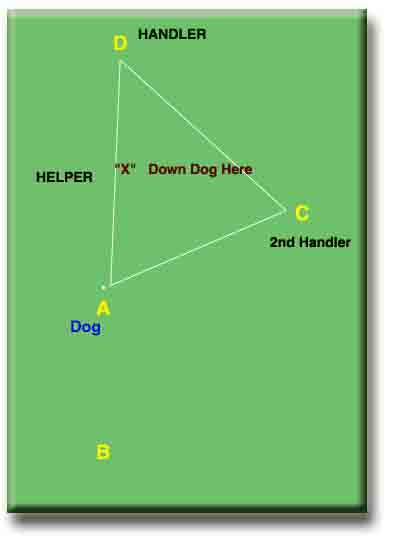
When the dog does this, we will put the dog in a down position (Point "A" or "B" in the diagram above) and move almost opposite of the helper (point "D" in the diagram). So the dog must run right by the helper to get to the handler.
Here it often helps if a 2nd handler works the long line. If it's set up properly the 2nd handler can be on the point of a triangle (like in the diagram). He will have enough control of the dog, through the long line, that the dog will not be able to get to the helper even if he wanted to try. Test and verify the swing of the line before doing the exercise.
It's during this stage of training that I will add a drop on recall. This will be right in front of the helper. During this work, if the dog will down, I will sometimes allow him to go and fight with the helper after he does the down. Other times I will finish the recall before he is allowed to go and fight. This random work keeps the dog thinking and focused on the helper.
When I choose to allow the dog to fight out of the down, I make it very clear to the dog and the helper by giving a "PACKIN" (bite) command. This command tells the helper to move. He will stimulate the dog and the dog knows it's OK to fight. This exercise also helps teach the "bite on command." Eventually, we will want the dog to bite a standing still suspect that does not stimulate the dog. There are situations in police work where this is required (i.e., a felony suspect who will not respond to an officers' commands while being taken into custody).
When the dog will do recalls past the helper 3 times in a row, we are ready to start recalls. I have found that some dogs do a better job by "downing" partway to the helper and then being recalled from the "down." Other dogs will do a recall while running towards the helper. They will do this from the beginning of this stage of training. Dogs that do this have handlers who are very clear pack leaders to their dogs, dogs with rank problems will have problems with this work. You must determine what works best with your dog. Tactically I like a dog that can do both.
Dogs are creatures of habit, for this reason, it's very important that K9 handlers start every session the exact same way that they will deploy a dog on the street. I like to kneel on the ground, my hand on the dog's collar, and with my dog by my side in a sit or down. Even during training, I will make the announcement "Sheriff's Department - come to my position or I will release a police dog." By doing this I am telling the dog exactly what is going to come next. It builds drive and makes it very clear that he is not going to do drug work, he is about to be put into a position where he may have to fight a man.
Initially, the dog is sent on a long line (this is later changed to a 6' leash.) In the first stages, the recall is given when the dog is only about 10 yards from the handler. The closer the dog gets to the helper (and further from the handler) the more difficult the distraction for the dog. That's why the initial recall is right after the dog is sent. But remember - the dog is always sent back for a fight the second it gets back to your side.
If new handlers make the mistake (in the beginning) and let their dogs get too far away from them before doing the recall, I can almost guarantee that new dogs will want to go in and fight.
Should a dog break through the recall command and go into bite, the helper should not fight the dog. The sleeve should go limp (dead). A helper that fights only reinforces the dog's decision to ignore his handler and fight the helper. So the instant the dog breaks through the recall, his handler needs to charge the dog screaming "NO, NO, NO" like a crazy man.
When the dog makes a mistake, it's important that the handler not charge his dog with the "OUT" command. Here's why: the dog needs to know that he made a mistake. If the handler charges up and gives an "OUT", the dog will have an opportunity to come off the bite and therefore mind his handler. If the handler then grabs the leash and corrects his dog (for not doing a recall) he will only confuse his dog that has just obeyed the "OUT" command.
So, to keep everything very clear for your dog, the handler charges the dog screaming "NO, NO, NO." The handler then takes his dog all the way back to the point where he was sent, along the way he will correct his dog for not coming when called. The long line goes back on and the dog is either sent again, after another announcement, or we go back to step 2 and step 3 of training.
During this training, it's important to occasionally send the dog and allow him to go straight in and fight the helper (who you have a prearranged signal.) If I see my dog begin to anticipate the recall (which means he is learning) I will give a Packing command, which will be the signal for the helper to escape and the dog will then go in for a fight.
Once the dog begins to become consistent, I will begin to introduce F&B into the exercise. When I do this, I will put the dog back on the long line and I will only expect the dog to bark 2 or 3 times before he is given a fight. As the dog improves, we can incorporate the F&B into the dog being sent. During the F&B training I will always determine when the bite takes place by having the helper move on my "Packin" command. The goal here is to eventually have a dog that will bite on command without the helper having to move to initiate a fight.
When I do this training, I always use an electric collar at the step where the long line comes off. The scope of this article is not to discuss the foundation training of using a collar.


Most Popular Articles
-
01
-
02
-
03
-
04
-
05
Related Products
-
 $34.99 - $44.99
 -
$46.96 - $81.62
$37.99 - $67.49



Ask Leerburg.