



The Importance of Fight Drive in Building Searches


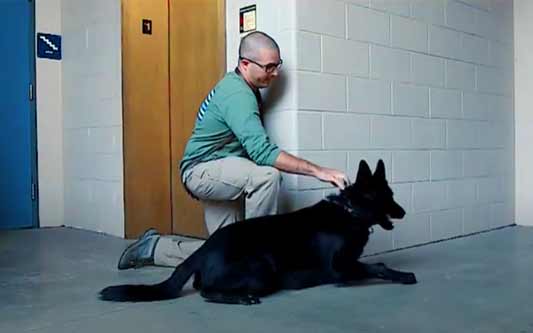
I feel that it's important that new handlers understand the subtleties between how a fight drive dog and a prey dog view this work. It's also important that people understand that there are many police dogs that are currently working in prey drive in a building search. This is wrong.
There are only two drives that should take place in a building search - HUNT DRIVE (HD) and FIGHT DRIVE (FD). Through proper training a dog uses HD to find the odor of a hidden suspect, as soon as the odor is found a dog should switch drives and go into FD.
If the dog has good FD, he is more inclined to indicate on odor. The reason is simple: he sees the helper (or suspect) as a fighting partner and when the dog gets into the odor of someone, he thinks he may have to fight he will have learned that by barking he is actually calling the handler for backup. It's like the dog is saying "Hey Dad, I found the SOB over here. Come and help me take care of business."
The bark of these FD dogs is a deeper more defensive type of bark (although there is a difference between a defensive bark and a FD bark). A FD bark has more seriousness, more confidence.
A dog that only works in prey drive does not look at the odor of a hidden suspect in the same way as a FD dog does. He sees the helper as a big prey item and prey dogs do not like sharing their prey. The reason they bark is to try and flush the prey into moving or running so they can capture it, not because they are calling their handler for help.
Prey dogs do not like to share prey, even in a wolf pack the prey is divided according to rank within the pack. With lower pack members getting the less choice parts of the prey. This is one reason why prey-based police or sport dogs are more difficult to control in obedience on the man - they simply do not want to share.
Years ago, in the early 1970s and 1980s, a ton of dogs came over from Europe that would go out on the training field and bite the hell out of helpers. Trainers and handlers were very impressed with the intensity of these dogs. The problem was that the vast majority of the dogs were big prey dogs which became almost impossible to control in obedience. This is one of the main reasons why they had so many problems with the OUT. A Prey dog does not like giving up his prey. This is probably why these dogs were sold in the first place.
This is one of "THE MOST IMPORTANT" concepts that new handlers need to get in their heads. They need to learn to train a dog to work in FD. The problem is, not very many police dog instructors even know how to do this properly.


Most Popular Articles
-
01
-
02
-
03
-
04
-
05
Related Products
-
 $30.00
 -
 $45.00
 -
 $10.00



Ask Leerburg.