



Blood Tracking


Using dogs to help find wounded animals is an old technique that has its origin in Europe. But in North America also, dogs were used by the early white inhabitants to find wounded big game. The basis for this was the realization that dogs are superior to man in following faint trails with little or no visible blood. At first, there were probably no ethical motivations and specialized dogs were used to recover wounded game simply because this produced more meat and hides.
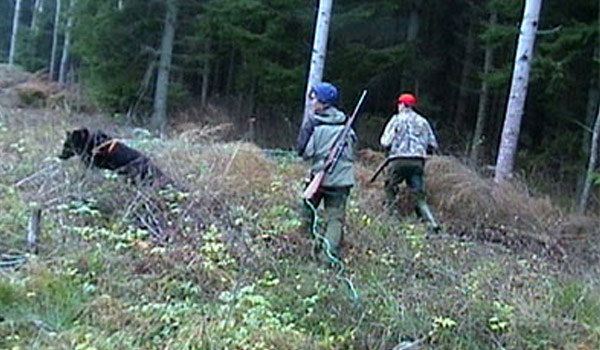
Today, most hunters take great pride in recovering their wounded game. Of course, one reason is food, but most important is the ethical concern that an animal should not suffer unnecessarily. The decision to use a tracking dog is above all an ethical one. So when hunting one should strive to minimize the suffering of a wounded animal, and this is best achieved by having a highly trained and specialized blood tracking dog.
In this context, it is interesting to mention that in Norway, my own country, all hunters must have access to an officially titled and registered blood tracking dog in order to get permission to hunt roe deer, red deer, and moose. And as a result of this, there are many blood tracking dogs and a lot of people involved in training and judging tests and competitions.
Today, blood tracking dogs also do an important job when animals are hit by cars every day around the country. To find a wounded roe deer, red deer, or moose, which has been hit by a car and has run out of sight into the woods, may be as difficult a task as anything encountered in hunting season. Hunters and dogs do an excellent job of reducing the suffering of wounded animals.
The test to become a titled blood tracking dog in Norway—or ettersøkshund as we call it—onsists of two parts. The first part is to follow a fresh track of a roe deer, red deer, or moose for at least half an hour and the second part is to track a 600-meter blood line laid with 90 degree turns, a couple of ten-meter gaps in the blood line, a wound bed and so forth. We use 0,3 litres of blood for this distance, and the track should be 12-24 hours old and laid in varied, wooded terrain. There are many rules concerning the judging and certification of a dog, but I won't go into the details in this article. I will mention though that the judgment and rules are always based upon the assumption that a dog and handler must work satisfactorily as an effective team during real work. I will point out that passing this blood tracking test establishes the dog with a title as an officially registered dog. But this is just the first step. It is after this point that the advanced training takes place. Most hunters settle at this level and train some now and then and that's fine. Some hunters also advance into more complicated training steps and develop their dogs even more.
An experienced blood tracker and breeder, John Jeanneney, points out that the North American approach is to train the dog more through natural experiences on the scent lines of real wounded deer once the basics have been learned on artificial blood lines. Beyond the entry-level, dogs develop their expertise through natural tracking. The European approach, with an emphasis on formal training and tests, makes good sense in the European context.
Tracking dogs must learn to track faint, day-old scent lines of wounded animals for long distances in varied terrain. The animals may have run at full speed if frightened, and they may have bled very little; it is important that the dog be able to handle weak scent lines. At the same time, it is essential that the dog learn to ignore the fresher scent of healthy animals that have crossed the tracks of the wounded one. If a dog runs off because it finds the fresher tracks more tempting, the dog is worth little at that moment and needs more training. Sometimes this may be a problem with certain dogs, but it is nothing so serious that a good trainer cannot resolve it in a short time.
One can never be one hundred percent certain that a shot was a miss when the animal runs out of sight. That's the reason why the dog and handler are judged also by their abilities to follow the fresh track of a healthy animal. The deer doesn't necessarily show any signs of a hit, and you have to track the animal for some distance to be sure that it is unwounded and all right. This is why we automatically put the specialized blood tracking dog on the track after an hour or two (the waiting is due to the fact that a wounded animal will lie down much sooner if not followed). Signs of blood are not a safe way to determine if an animal is wounded or not.
Blood tracking with dogs today has become a sport and hobby for many hunters, but it is also a necessity when hunting. So, this “inner motivation” that hunters have to train and develop a reliable blood tracking dog, for the fun and challenge of doing it, has had an important result. There has been an enormous gain in knowledge and expertise over the last decades; the refined training techniques and the specially trained dogs, used only for blood tracking, have increased the effectiveness of the searches for wounded game. A lot of hunters still use their hunting dogs also as a blood tracking dog – it's convenient, but it's not a good idea. A hunting dog (let's say a Norwegian Elkhound) that has tracked moose all day long off-leash isn't exactly a fully rested and highly motivated dog to put on a leash for a long and difficult blood tracking job in the evening. It will not perform at its best when it has already done a full days job. So in this context, I believe there's a great niche for the working type breeds like the GSD, Malinois, Belgian Sheepdog and Doberman when it comes to tracking wounded game. Not as hunting dogs, but as highly trained specialists when there's need for a good blood tracking dog.

Most Popular Articles
-
01
-
02
-
03
-
04
-
05
Related Products
-
 $92.50
 -
 $10.00
 -
 $21.99 - $79.99
 -
 $20.00


0 Comments
Ask Cindy
Sorry, adding comments is currently disabled.