




Key Features
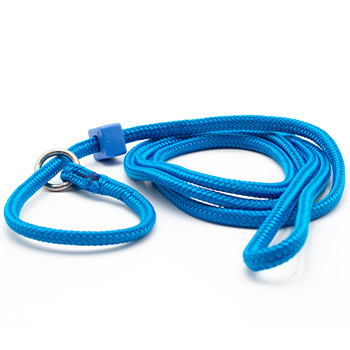
- Made with soft non-stretch hollow core polypropylene rope
- Sizes 9-11 have solid brass snaps
- Size 12 may have brass or SS snaps
- Sizes 13-24 have stainless steel snaps
- Handmade by Leerburg in the Wisconsin
- Can be used for corrections or as a backup in conjunction with a prong collar
Product Description
Our dominant dog collars (DDC) were designed by Ed Frawley (the owner of Leerburg) back in the 1990s to control reactive dogs that display aggression towards their handlers, other people, or other dogs. They offer a much better solution to aggression problems than a prong collar or a remote collar.
DDC collars have saved the lives of thousands of dogs over the past 25 years that otherwise would have been euthanized because dog owners did not have the right tool to solve behavioral issues with their dog.
Read The Story Behind Dominant Dog Collars vs. Slip Collars for more information.

How to Measure for a Dominant Dog TRAINING Collar
When a DDC is fit correctly, it rides right up under the dog's jaw and close behind the dog's ears. DDCs are designed to fit snugly on the dog's neck. There should not be much slack. A well-fit DDC only has one to three inches of slack when attached to the leash.
To get your dog's measurement, use a string or cloth measuring tape. Run the string right up under the dog's jaw and right behind the ears. Then take that measurement and add 2 to 3 inches.
If you brought your dog into our office, we would try multiple collars until we only had 1 inch of slack, which would be the perfect fit. If you want to purchase several sizes of collars and return those you don't want to keep, we will refund your returns (as long as they have not been used and can be sold as brand new collars). The only downside in doing this is you would have to pay return shipping charges.
Or you could keep the long collars and use them as backup collars if you use a prong collar.
Why a Dominant Dog Collar Works So Well
Dominant dog collars are designed to wrap around the dog's neck and clip on, unlike a nylon slip collar that has to go over the top of a dog's head just to get it on. When a DDC is properly sized it only has 1 to 3 inches of slack for the leash to clip onto. This means the handler only has to move the leash a couple of inches to tighten the collar and get the dog's attention.
Slip collars, on the other hand, don't wrap around the neck to go on, they have to go over the top of the dog's head and slide down the neck. It is not uncommon for dogs with big heads (i.e. Bulldogs, Rotts, Pitties, ect) to need a really long slip collar just to get over the head and get on the dog.
This results in the slip collars ending up being 5 to 9 inches longer than they need to be. That results in the slip collar hanging low on the neck with many inches of slack. When that happens, handlers have to move his or her leash the length of that slack before they even get the dog's attention. This dramatically affects the timing of your training correction or the timing of getting control of the dog that is acting inappropriately.
There are two uses of a Dominant Dog Collars
1 - They are used as a Training Collar - see above.
2 - They are used as a back-up collar when training with a prong collar. Prong collars can and do come apart when not sized properly or if prongs are bent and loose. When a handler doesn't have a back-up collar on their dog, when the prong comes apart, they find their dog OFF LEASH at a time they need control of that dog. That's the moment in time they wish they had a back-up collar on the dog.
DDC as a Back-up Collar
When trainers use prong collars, we always recommend using a second back-up collar (like our DDC) to ensure the dog remains on leash and under control if and when the prong accidentally pops apart.
This always happens because the prong collar is too big and has not been adjusted to fit properly. Those collars are just hanging around the dog's neck.
Keep in mind if there isn't a backup collar on the dog it is now off leash is a bad scenario.
That's not good.
We have made and sold multipe type and sizes of Prong Collar Leashes for years. These leashes have 2 ends, they are designed to clip to two collars.
When your DDC has to much slack?
When an aggressive dog is trying to bite its handler or is being reactive and the handler is forced to give a firm correction to get control, a common response is for the dog is to turn its head and try and bite the collar or leash. If your slip collar or a dominant dog collar is way too long a dog could possibly chew through it.
This is another reason why we only want 1 to 3 inches of slack in a DDC or a slip lead.
99% of Dogs are not Dominant
We get emails every day of the week through our ASK CINDY Portal on the front of our website. A great many of these are from people who feel like they have a dominant dog.
The fact is 99% of those people do not have dominant dogs, they have reactive dogs or they have spoiled dogs that have been allowed to practice bad behavior. Most of those dogs can be retrained (many with a lot of work).
That 1% that are truly dominant are not going to have the dominance trained out of them. Dominance is genetic and a dominant dog will always be dominant. They can be controlled, and they can learn to respect an assertive handler, but those dogs will always be looking for a chance to fight the handler and be the leader.
A truly dominant dog should be trained with a dominant dog collar (not a prong collar) and that collar needs to be on that dog every day of its life.
If you want to learn about dominant dogs, I produced an excellent online course titled DEALING WITH DOMINANT AND AGGRESSIVE DOGS.
How to use a Dominant Dog Collar
We are often asked how to use our DDC. The first part of the answer is to make it clear that the DDC was not designed or meant to give a POP correction (like with a prong collar). When the dog requires a correction, simply tell the dog "NO" and then take all the slack out of the leash as you apply pressure by lifting straight up.
Continue to apply upward pressure until your dog offers a behavior change. As soon as you see that change, you should immediately release upward pressure. How much pressure to apply depends on the dog and the circumstances you find yourself in, as well as the level of distractions. More about this below.
The key to this training is to remain calm. Don't sound angry, hectic, or worried. Don't scream at your dog. Simply say "NO" in a normal tone of voice. Before applying upward pressure, make sure to give the dog a second to respond. If it doesn't respond or ignores your "NO", then lift up.
If you are consistent EVERY time the dog acts inappropriately, most dogs learn very quickly to offer a behavior change. Dogs who have been allowed to practice bad behavior for some time will require more upward pressure for a longer period of time before their behavior changes. This work is going to take repetitions for a dog to learn to respect the handler when told "NO", but when done correctly, every dog will learn to respect a "NO" command and the power of a DDC.
Unlike a prong collar correction, DDC are not painful for the dog. While a prong collar can and will often trigger an aggressive or hectic response back towards the handler, that seldom happens with a DDC. If it does happen, the trainer should remain calm and continue to apply very firm upward pressure until the aggressive behavior stops. When you stop, say nothing. Do not praise or pet the dog, as this may encourage a fight. Simply act like nothing happened and continue on with what you were originally trying to do (unless the dog is aggressing towards people or other dogs, in which case you should turn and walk away).
It must be said that if you're reading this, you have some form of behavior issue with your dog. I would also guess that you agree with me when I say that giving a dog with behavioral problems to a rescue (where the bad behavior will continue) or putting the dog down is not a fair solution for a problem that most people have allowed to happen.
Killing a dog over behavioral issues must always be the last solution. Using a dominant dog collar correctly and managing a dog properly is a far better solution.
If you feel you need additional training help for a dog aggression issue, I would recommend my online course titled DEALING WITH DOMINANT AND AGGRESSIVE DOGS. This course does a deep dive into the causes of dog aggression and pack structure. It is well organized and has over 20 hours of training information.
Dominant Dog Collars and Handler Aggressive Dogs
I have trained police service dogs and dogs for the biting dog sports since 1974. For a number of years during the 1980s, I imported selection-tested adult dogs for police service work. Most of these dogs came from homes in Germany where the high drive dogs were allowed to run the house. The owners inevitably gave them up because they simply could not handle them.
When these dogs came to my kennel, most of them came with behavioral baggage. It was common for the dogs to resort to handler aggression when asked to do something they did not want to do. They needed to learn that handler aggression was not a tool they could use. I solved these issues by using dominant dog collars. I have a great deal of experience working with seriously strong aggressive dogs.
If animal rights people saw the arguments I had with many of these dogs, they would probably go a little crazy. They would say that those dogs needed to be put to sleep--but they would have been dead wrong. In every case, the dog's issues just needed to be cleared up and they were over it. Every one of those dogs (except one that had a brain tumor), went on to have a full, productive career in law enforcement.
Disclaimer
If you are new to this product, it is important that you understand how the product is intended to be used. This collar should not be used to give a leash correction. It is not intended to be used in the "yank and crank" manner, where a trainer jerks the dog around to give corrections. Attempting to do so with this collar or with a metal choke collar will damage the throat of your dog.
Our dominant dog collar should only be used in the manner explained here and as demonstrated in our DVDs. If you use the dominant dog collar correctly, it is the best collar available to solve serious unwarranted aggression problems, but if you use it to jerk your dog around to administer leash corrections, you could very easily injure your dog.
This collar is meant as a training collar and not to be used as an “everyday” collar and should not be worn without direct supervision. We advise that this collar is used for walking or training and then removed at the end of the session.
Leerburg will not be held responsible for any injuries that result from the improper use of dominant dog collars.
Due to government restrictions, countries like Australia and several in Europe do not allow the use of remote or electric collars. Dominant dog collars are a viable alternative.
Nylon vs polypropylene rope - what's the difference?
On the surface, they appear to be identical, and they do share many similar features. For example, they're both constructed from industrial-grade synthetic materials, making them a stronger alternative to natural fiber ropes. Additionally, both materials are resistant to UV rays, abrasion, and rot.
But there are some key differences between the two, which make them either more suitable or less suitable for certain jobs.
The 3 differences between nylon and polypropylene
-
Flexibility
Nylon has a high level of flexibility. When necessary, it's possible to stretch nylon rope by up to 20% without affecting its strength - and it will simply return to its original size afterwards. This makes it particularly good when you need the rope to be more shock absorbent, such as towing or mooring.
This is not a feature we want with slip leads or dominant dog collars
-
Absorbency
Both nylon and polypropylene sink in water. However, they differ greatly in terms of their absorbency.
Although nylon rope is normally very strong it absorbs liquid quickly and easily, and this compromises its strength significantly. The fibers become waterlogged and start to sag. They also take a long time to dry. Therefore, nylon isn't the best option for wet conditions.
Polypropylene ropes, on the other hand, do not absorb water. They retain their normal level of strength when they're wet and, as a result, they are a better choice for dog training applications.
-
Temperature resistance
Another important difference between nylon and polypropylene is their resistance to heat. Nylon rope cannot withstand heat as well as polypropylene. Polypropylene is typically a better choice for working in higher temperatures.


Have you used this product?
Your review helps others choose the right products for their dogs. Let them know what you think!
Write a Review


I swear that the sizing information on the website has changed. Before, there was a calculator that told you which size to buy automatically. That calculator has now been removed (maybe because it was wrong). I used that sizing calculator, and the size I was told to buy was wrong. I measured 13 inches and was told to buy a 12 inch.
The sizing information that I can see today on the website today says the opposite, and it says to add inches and go up from the measurement! So I should have gone up not down. I can't prove this, because I think they've changed the website since I purchased.
I can't even return the item, because the shipping cost more than the item itself (I'm overseas in Australia). The return policy states don't cover the cost of shipping for the return, so I'm better off just taking the loss.

Instead of getting pulled down, I can lift his front off the ground to get his attention when he makes a bad choice of not listening to me on a walk. Did not expect this to work so well with a small collar
I had to exchange mine for a smaller size because I measured incorrectly...Leerburg has the Best customer service! Thank you!

Kelly Donovan

I also use it during training in my show collar as a back up line.
So often GSD show DOGS develop a habit of slipping the show line and run off away from the handler back to their owner...which is annoying in the show ring ..SAFETY IS ALWAYS number 1 priority. GREAT COLLARS

This collar works great for training. It gives a quick pop & release & is MUCH friendlier than metal chocks. (never use metal on puppies)
Big runs in the family. I used this type of collar training my now 140 pound Rottie.
Very pleased & would highly recommend this product.

Dominant Dog Collar




Related Courses



New Online Courses